Live Scan Fingerprinting Fees in California
The cost of a California Live Scan depends on two things: government processing fees and the rolling fee charged by the fingerprinting provider.
The exact amount you pay depends on what your employer, licensing board, or other requesting agency lists on your Live Scan form. You need to understand what fees you pay before you book your appointment. If you’re not sure why you were sent for fingerprinting in the first place, start with what a Live Scan background check actually covers.
What Does a Live Scan Fee Include?
The price you pay for a Live Scan is made up of charges for two different parts of the process: the rolling fee charged by the fingerprinting provider and any government processing fees required for your application. Knowing the difference helps you understand which part of the price can vary between providers.
The Rolling Fee
The rolling fee is what the fingerprinting provider charges to take your fingerprints, process them, and electronically submit them. It covers the operator, equipment, and transmission.
The California Department of Justice does not set the rolling fee. It varies by location. Check the provider’s price before you go. Note that mobile fingerprinting typically costs more because the provider travels to you.
Government Processing Fees
Government fees cover the criminal background checks run by the California Department of Justice and, when required, the FBI. Unlike the rolling fee, these amounts are set by the government.
You cannot reduce these fees by choosing a different fingerprinting location. The Contractors State License Board confirms that it does not set the rolling fee either, because each Live Scan site sets its own. When comparing Live Scan providers, the rolling fee is the part of the price that can vary.
How Much Are the Government Fees?
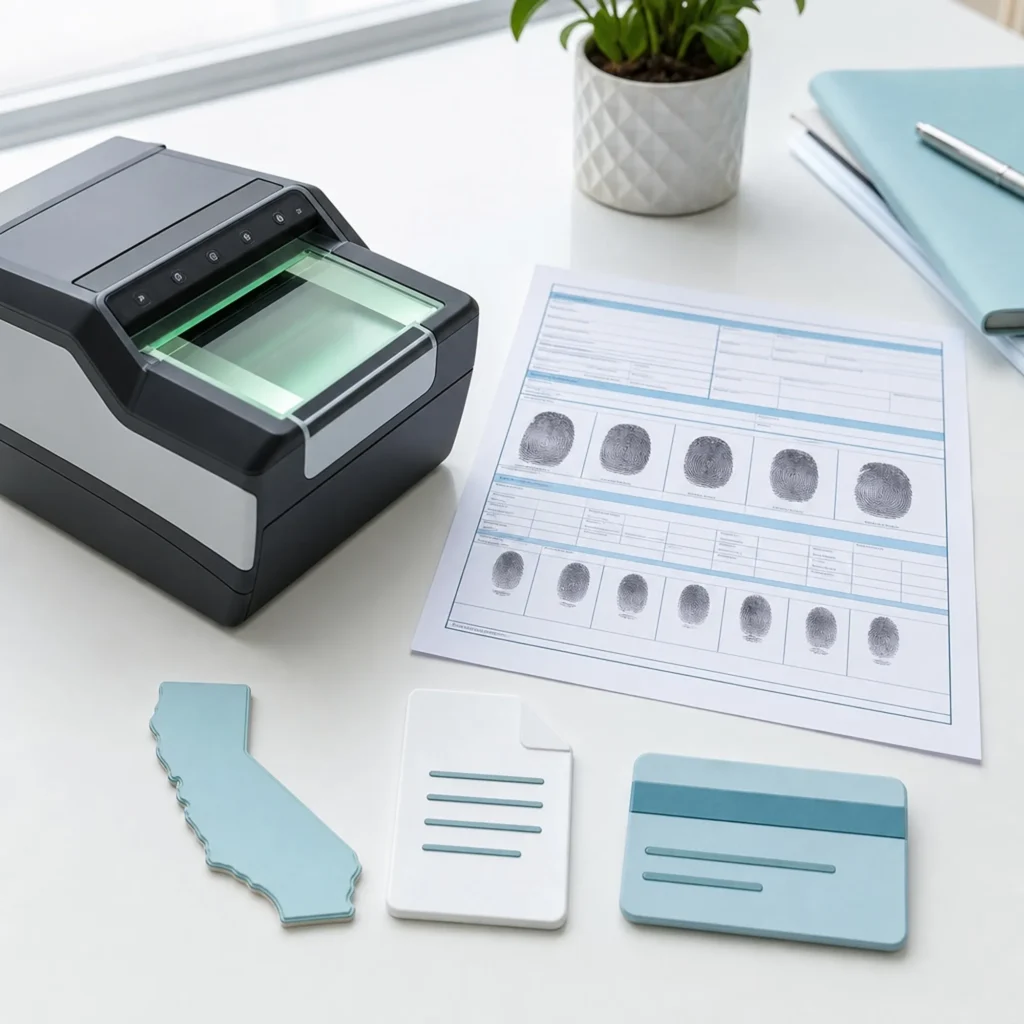
Government fees vary depending on the type of Live Scan application. A general employment or licensing application may have different fees from a volunteer, child-care, firearms, or record-review submission.
The table below lists the California DOJ’s current Applicant Fingerprint Processing Fees. Check the official DOJ fee schedule before your appointment, because government fees can change.
Specialized applications can also have additional charges. Firearms-related and fingerprint roller certification applications may include extra government fees beyond the standard processing charges. Fingerprinting for a visa or immigration matter follows its own rules, which the DOJ’s visa and immigration fingerprinting page explains. Check your Live Scan form and the current DOJ fee schedule to see which fees apply to your application.
Why Can’t a Live Scan Provider Give You an Exact Total Over the Phone?
Your total depends on what is listed on your Request for Live Scan Service form, not just the fingerprinting provider’s price.
Your employer, licensing board, or other requesting agency gives you this form. Most use Form BCIA 8016, although some agencies use their own version. The form includes an ORI number, which identifies the requesting agency, and the type of application being submitted.
Those details determine which government fees apply. As a result, two people can be fingerprinted at the same location on the same day and still pay different government fees.
If you want an exact quote before you arrive, have your ORI number and application type ready when you call. The provider can use those details to determine the applicable government fees and add the site’s rolling fee.
Does Your Form Have a Billing Number?
A billing number means your employer or requesting agency already has an account with the California Department of Justice and is covering the applicable government fees.
Check your Live Scan form before you pay. If a billing number is listed, you generally pay the rolling fee only. Do not pay the government fees again. If you are unsure, ask the fingerprinting provider to check the form before your fingerprints are taken.
Do Volunteers and Nonprofits Pay Less?
Some do. The DOJ fee schedule provides lower FBI fees for certain volunteer applications and waives the California state fee for specific nonprofit and youth-organization categories.
Whether you qualify depends on the ORI number and application type on your form, not simply on the fact that you are a volunteer.
Do You Have to Pay Again If Your Fingerprints Are Rejected?
Usually, government processing fees are not charged again when fingerprints are resubmitted under the original ATI number. State agencies confirm that no DOJ or FBI processing fee applies on a resubmission as long as the original ATI number is included. However, the fingerprinting provider may charge its own rolling fee for the second visit. Ifyou come to the same provider with the rejection letter within 30 days from the original date of the first visit, the provider must do resubmission free of charge. If the fingerprints will be rejected the second time – DOJ will run your records by using your social security number.
The Contractors State License Board also warns that if a second submission is rejected, the background check may move to a slower manual name search. That can delay the result. Following the fingerprinting instructions carefully the first time can help you avoid another visit.
What Does a Mobile Live Scan Cost?
Mobile Live Scan costs more than an in-office appointment because the fingerprinting provider travels to your location. The final price depends on factors such as your location, the number of applicants, and travel requirements.
Mobile service can be useful when several employees need to be fingerprinted at the same workplace, when a group needs appointments at one location, or when traveling to a fingerprinting office is difficult.
What If You Are Outside California?
If you live outside California and cannot access a California Live Scan location, you may need to use a fingerprint hard card instead. California agencies such as the Bureau of Security and Investigative Services allow out-of-state applicants to submit fingerprint cards for certain background checks.
The most common hard-card form is FD-258. Your local police department, sheriff’s office, or another authorized fingerprinting provider may be able to roll your fingerprints onto the card. The completed card is then submitted according to the instructions from the California agency handling your application.
Before You Get Fingerprinted
Check the instructions from the agency requesting your fingerprints before you get fingerprinted. Different licensing and certification agencies can have different requirements for out-of-state applicants.
For BSIS applications specifically, hard-card processing takes a minimum of 8 to 12 weeks, according to the agency. Other California agencies may have different processing times. Electronic submissions are returned far faster, so if you can be in California, that is the quicker route.
Can You Get Your Own Live Scan Results?
Usually, no. For most employment, licensing, and certification Live Scans, the results are sent to the agency that requested your fingerprints. If you want to check the status or see your own California criminal history, there are separate ways to do that.
Can You Get a Copy of Your Background Check?
For a standard employment, licensing, or certification Live Scan, the results are sent to the agency that requested the background check. If an adverse employment, licensing, or certification decision is based on the results, the agency must provide you with a copy.
How Can You Check Your Live Scan Status?
Yes. You can check the status of your fingerprint transaction through the California DOJ’s Applicant Background Check Status system. You will need the 10-digit ATI number from your Live Scan form and your date of birth. Keep in mind that the status system shows the progress of the fingerprint background check; it does not tell you whether your application was approved.
Can You Request Your Own Criminal Record?
Yes. You can request a copy of your own California criminal history record through the DOJ’s Record Review process.
A Record Review is for checking your own record for accuracy and completeness. It is not a substitute for an employment, licensing, or immigration background check. The DOJ specifically says a Record Review cannot be used for visa or immigration purposes.
What Should You Bring to Your Live Scan Appointment?
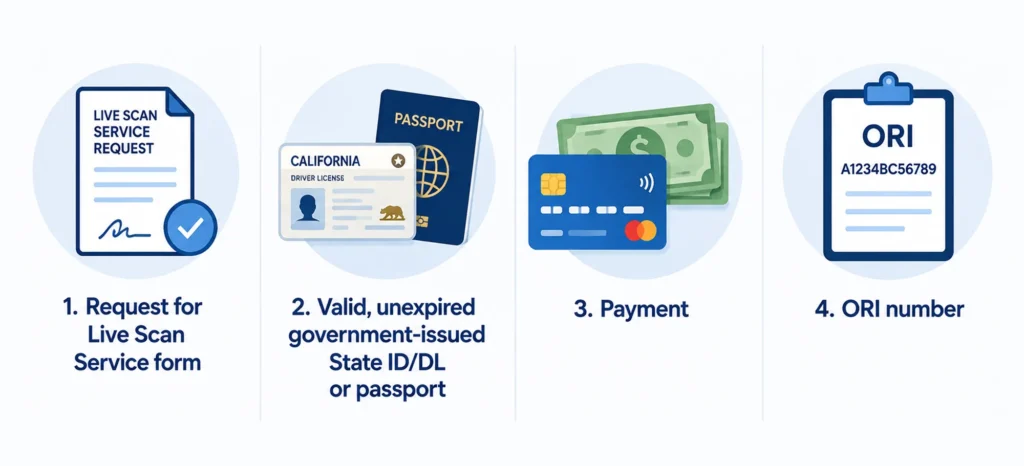
You simply need to bring these four things to avoid delays or having to make another trip:
Request for Live Scan Service form
Your employer, licensing agency, or other requesting organization should complete the form. The fingerprinting provider does not issue it.
Valid, unexpired government-issued State ID/DL or passport
Make sure your identification is acceptable before your appointment if you’re unsure.
Payment
Bring payment for the provider’s rolling fee and any government fees not covered by a billing number.
ORI number
Keep the ORI number from your form handy if you want to confirm the applicable government fees before your appointment.
Where Can You Get a Live Scan?
Choosing a Live Scan provider is about more than finding the closest location. Check that the provider is authorized to submit Live Scan fingerprints to the California Department of Justice and that the location offers the type of appointment you need.
If you need other document services at the same time, ask whether they can be handled during the same visit.
FAQ
How Much Does a Live Scan Cost in California?
The cost depends on your application. There are 2 fees that need to be paid: government fees which vary from application to application and starts from $17 and up, and provider’s fee – starts from $25 and up. Double check with your provider how much they charge for their services.
Is the Live Scan Rolling Fee Set by the State?
No. The California DOJ does not set the rolling fee. Each fingerprinting provider sets its own fee, which is why prices can vary between locations.
Why Is My Live Scan More Expensive Than Someone Else’s?
The government fees depend on the application type and ORI number on your Live Scan form. For example, a general employment check may have different fees from a care-facility, volunteer, or firearms-related application.
Can I Pay by Card, and Is There a Surcharge?
Payment methods and card surcharges vary by provider. Check with your chosen Live Scan location before your appointment so you know what payment methods are accepted and whether an additional fee applies.
Do I Have to Pay Again If My Fingerprints Are Rejected?
Government processing fees are generally not charged again when fingerprints are resubmitted under the original ATI number. However, the fingerprinting provider may charge another rolling fee. The Live Scan processing timeline also explains how a resubmission can affect timing.
Who Pays for the Live Scan: Me or My Employer?
Check your Request for Live Scan Service form for a billing number. If one is listed, the requesting agency may already be covering the applicable government fees. You may still be responsible for the provider’s rolling fee.
Do I Need a Live Scan Appointment?
Appointment requirements vary by provider. Some locations accept walk-ins, while others require appointments. Check with the location before you go to confirm availability and what you need to bring.
Can I See My Live Scan Results?
For most employment and licensing applications, the results are sent to the agency that requested the background check. You can check your Live Scan transaction status using your ATI number, or request your own California criminal history through the DOJ’s separate Record Review process.