USCIS Birth Certificate Translation
Nearly 1 in 5 U.S. immigration applications is delayed or returned due to document errors, and a non-compliant birth certificate translation is one of the most common causes. If you are applying for a green card, naturalization, or any visa that requires proof of identity, a single translation mistake can add months to your wait and hundreds of dollars in extra costs.
Our guide covers everything you need to know about the translation of birth certificate for USCIS in 2026: what the agency requires, who is authorized to prepare your document, how much it costs, and how to check your translation before you file. By the end, you will have a clear plan and a ready checklist.
What USCIS Actually Requires From a Translated Birth Certificate
USCIS sets out its translation standards under 8 C.F.R. § 103.2(b)(3). The rule is simple in principle but easy to get wrong: any document not written in English must be accompanied by a complete English translation and a signed statement from the translator certifying accuracy and competence. Understanding what “complete” and “certified” mean in practice is where most applicants run into trouble.
Everything on the Page Must Be Translated
USCIS does not accept partial translations or summaries. Every element on your original birth certificate must appear in the English version, official stamps, government seals, handwritten notes in the margins, the issuing authority’s name, and even notations that are faded or difficult to read. A translation that captures only the biographical data (name, date of birth, parents’ names) is not sufficient and will trigger a Request for Evidence.
This is really crucial as stamps and seals often carry legally significant information: the registrar’s authority, amendment notations, or court-ordered corrections. If those elements are missing from your translation, an officer cannot verify that the document is authentic and unaltered. Our USCIS-accepted translation services translate all visible text, official seals, and handwritten notes to ensure nothing is overlooked.
The Certification Statement: What It Is and What It Must Say
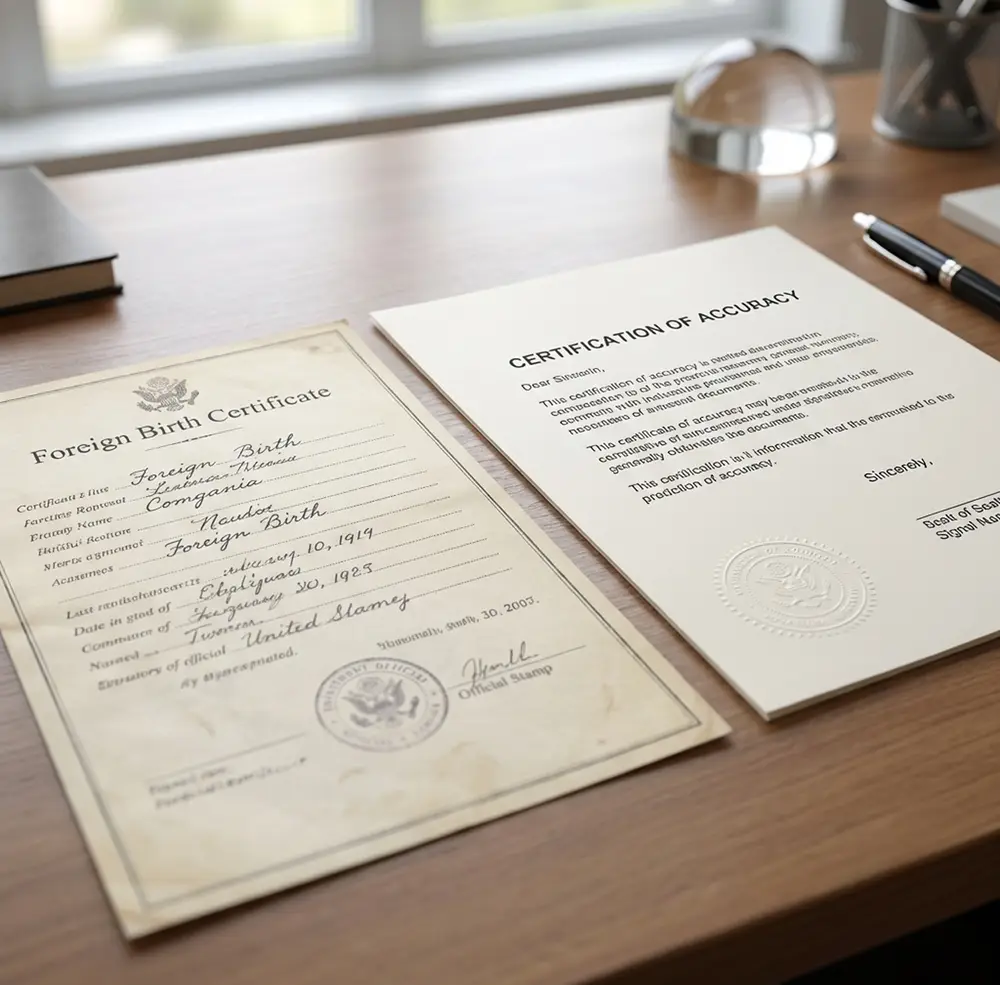
Alongside the translated text, USCIS requires a Certification of Translation Accuracy, a signed statement from the translator (or an authorized agency representative) confirming two things: that the translator is competent in both the source language and English, and that the translation is a true and complete rendering of the original.
Here is a sample you can use as a reference when reviewing your own translation:
“I, [Translator Full Name], certify that I am competent to translate from [Source Language] into English and that the above/attached translation of [Document Title] is true and accurate to the best of my knowledge and belief.
Signed: _______________
Date: _______________”
The statement must be signed by the individual translator, not just a company logo or agency stamp. If you are using a professional service, confirm that the actual translator’s name and signature appear on the certification.
Certified Does Not Mean Notarized
One of the most persistent misconceptions in immigration document prep is that certified translations must also be notarized. As of 2026, USCIS does not require a notary seal. A notary simply confirms the identity of the person who signed a document, it says nothing about translation quality or accuracy. USCIS cares about the translator’s competence and the document’s completeness, both of which are addressed by the certification statement alone. A signed certification is fully sufficient for USCIS filings.
That said, if your document will eventually be used abroad rather than domestically, notarized translation services and apostille certification may be required by the receiving country. These are separate processes from USCIS submission.
Who Can Translate Your Birth Certificate
Only a professional. Getting your birth certificate translated correctly is just as important as the translation itself, and choosing the right person to do it is a main part of that process.
You Cannot Translate Your Own Document
USCIS prohibits applicants from translating their own documents, regardless of language proficiency. The same rule applies to family members and anyone with a direct interest in the application outcome. The agency requires an impartial third party, not because your translation would necessarily be wrong, but because objectivity cannot be certified when you have a personal stake in the result.
Even if you work as a professional translator, you cannot translate documents for your own immigration case. Always use an independent translator or a professional service.
Why Is It Risky to Use a Non-Professional Translation
Some applicants ask a bilingual friend or coworker to help in order to save money. USCIS does not mandate a certified professional, but using someone without experience in legal document translation carries real risk. Peer translators often miss the formal register of official documents, handle specialized terms inconsistently, or produce a format that raises questions for an adjudicating officer.
The cost of one professional translation ($25-$50 per page) is almost always less than the cost of responding to an RFE, which may require hiring an immigration consultant and can push back your processing timeline significantly.
Is ATA Certification Necessary?
The American Translators Association (ATA) offers a rigorous certification exam for specific language pairs. USCIS does not require ATA certification, and there is no formal accreditation mandated by the agency.
So, choosing an ATA-certified translator or an agency that employs them is a strong quality signal, both for human officers and for the AI-assisted review tools increasingly used in immigration processing. When evaluating services, look for transparent credentials, a clear certification statement in the deliverable, and documented experience with USCIS submissions.
How Much USICS-Certified Translation Costs in 2026
The price of translating a birth certificate in 2026 is relatively affordable, but it does vary depending on who you hire, how fast you need it, and the language involved.
Standard rates for common languages
Standard language translation runs between $25 and $50 per page. Spanish and French typically fall at the lower end ($25-$35), while Arabic and Mandarin tend toward $35$50. Most birth certificates are one to two pages, so your total for a standard language pair will usually be $25-$70.
Rare and less-common languages
Somali, Amharic, Pashto, Haitian Creole, and similar, require specialized translators who are in shorter supply. Expect $50–$80 per page or more, with potentially longer turnaround times. If your document is in a rare language, plan ahead and build extra time into your filing schedule.
Urgent Translation
Same-day and rush certified translation service adds $20-$60 on top of the base rate for same-day or 24-hour delivery. For rare languages, rush fees can exceed $60 per page. Not all providers can accommodate same-day requests for every language pair, so contact your chosen service early if your deadline is tight.
Some agencies charge a flat per-document rate rather than per page, which can be competitive for short documents. Always ask whether the certification statement is included in the quoted price or billed separately.
How to Get Your Birth Certificate Translated: A Practical Walkthrough
Before contacting any translation service, prepare your document correctly. Use a flatbed scanner at 300 DPI or higher and capture every page, including the back if it contains stamps, seals, or annotations. Blurry or cropped scans are one of the most common reasons translations come back incomplete.
If your document has faded ink, water damage, or partially illegible text, note this clearly when you submit it to the translator. A professional service will translate all visible content and mark unreadable sections with a bracketed notation, for example, [illegible stamp], in the corresponding position. Do not ask your translator to guess at illegible text; an honest notation is both more accurate and more defensible with USCIS than a reconstruction.
Choose Your Translation Service Carefully
Look for agencies that explicitly provide a Certification of Translation Accuracy with every delivery, list their translators’ qualifications, and have verifiable USCIS experience. Well-regarded options in 2026 include RushTranslate, Tomedes, and specialized immigration translation agencies. For urgent needs, look for services that offer a compliance warranty alongside guaranteed turnaround.
Avoid generic freelance platforms without quality controls, and be cautious of unusually low quotes that do not explain how the service maintains USCIS compliance.
Look for a Mirror-Image Layout
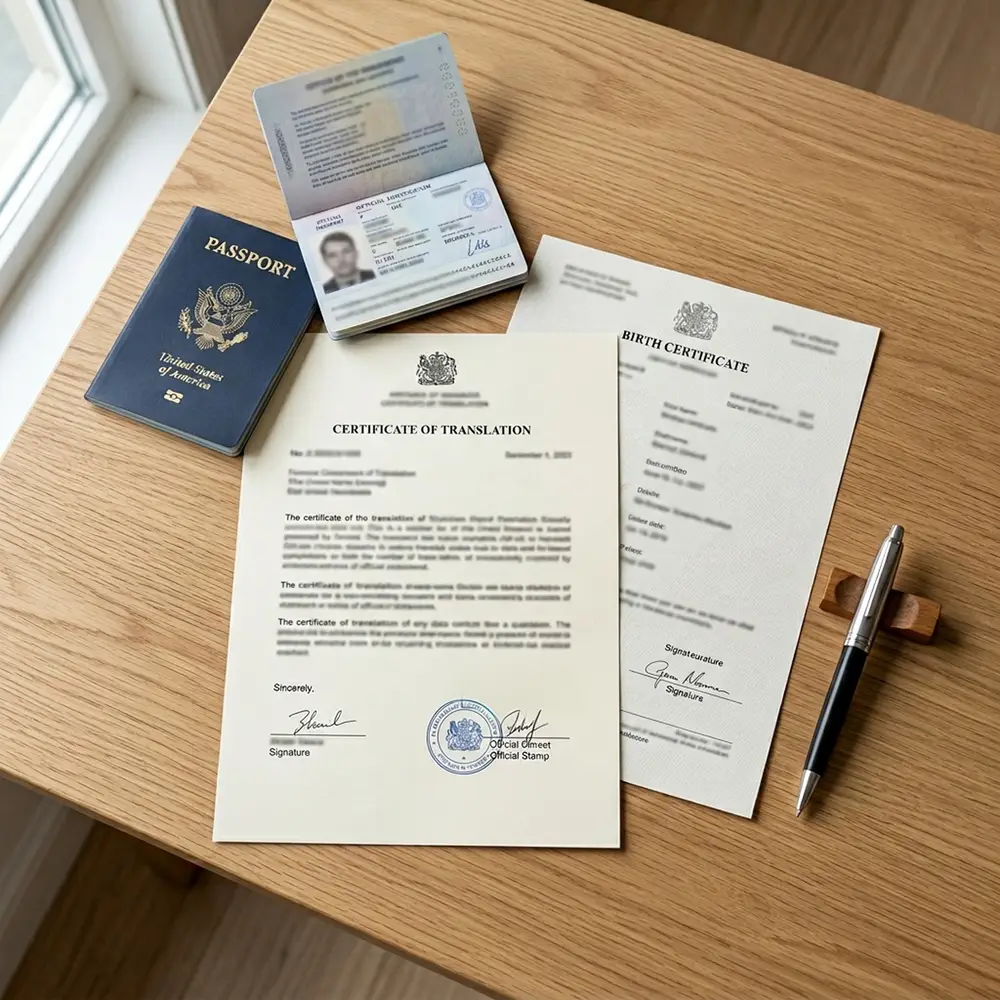
A quality USCIS translation uses a mirror-image layout: the English version replicates the visual structure of the original. Stamps appear where they appeared on the source document. Field order matches. Seals are described in their original position. This makes it easy for a USCIS officer to cross-reference the translation against the original without hunting for information.
A text-only layout, by contrast, presents everything as a plain paragraph document with no regard for the original’s structure. Both formats can be accepted, but mirror-image is the stronger choice, it reduces ambiguity and signals thoroughness. When you receive your translation, ask your provider whether they use this format; most professional agencies can accommodate it without additional cost.
Check the Certification Statement Before You File
Use this checklist before the translation goes into your application package:
| Element | Present? |
| Full legal name of the translator or agency | ☐ |
| Statement of competence in both languages | ☐ |
| Statement that the translation is complete and accurate | ☐ |
| Date of certification | ☐ |
| Translator’s original signature | ☐ |
| Contact information (recommended) | ☐ |
If anything is missing, contact your provider and request a corrected version before you submit. This is one of the most avoidable RFE triggers, and fixing it takes minutes when caught early.
Frequently Asked Questions
Can I translate my own birth certificate if I am fluent?
No. USCIS requires an impartial third party regardless of your language proficiency. This rule applies to applicants and to immediate family members equally.
Does USCIS accept digital copies of certified translations?
Yes, for most application types submitted through online portals. If you are mailing a paper application, include printed copies. Always confirm the required submission format for your specific form before filing.
How long is a certified translation valid?
USCIS does not publish a formal expiration period. A translation remains valid as long as the original document is unchanged. If your birth certificate has been reissued or amended since the translation was prepared, you will need a new one. For applications that have been pending for several years, some immigration attorneys recommend refreshing translations as a precaution.
What if my birth certificate is partially illegible?
Provide the clearest scan you can. Your translator will render all visible content and note illegible sections in brackets in the corresponding position of the English version. Do not ask for guesses or reconstructions, a bracketed notation is the USCIS-accepted approach and is far less risky than inaccurate text.
A Quick Recap Before You File
A compliant translation of your birth certificate for USCIS comes down to four things: it must be full and complete (every stamp, seal, and note included); it must carry a signed Certification of Accuracy from an impartial translator; it does not need to be notarized; and your name must match your passport exactly.
This week, pick one concrete step and take it. If you are preparing to file, get your birth certificate scanned at the correct resolution and request quotes from two or three verified services. If you already have a translation in hand, run it through the certification checklist above before it goes into your package.
Have you gone through the USCIS translation process recently? Share which service you used or what surprised you in the comments, your experience may save another applicant from a costly delay.