What Is a Notary Public Signature? How It Works and Why It’s Legally Required

If you’ve ever closed on a house, signed a power of attorney, or finalized a legal affidavit, you’ve likely been told you need a “notarized signature.” But what is a notary public signature, and why does it carry so much weight in the legal world?
A notary public signature is the handwritten or electronic signature of a commissioned notary public placed on a document to confirm that the notary witnessed the signing and verified the signer’s identity.
Notarization is also far more common than many people realize. According to the National Notary Association, more than 1.25 billion documents are notarized in the United States every year. These include real estate deeds, wills, loan documents, business agreements, and immigration forms. That averages to roughly four notarizations per American adult each year, making notaries a key part of document authentication in the legal system.
Despite how widespread notarization is, many people still do not fully understand what a notary public signature is, how the process works, or why notarized documents are widely accepted across all 50 U.S. states and in many countries around the world.
What Does a Notary Public Signature Include?
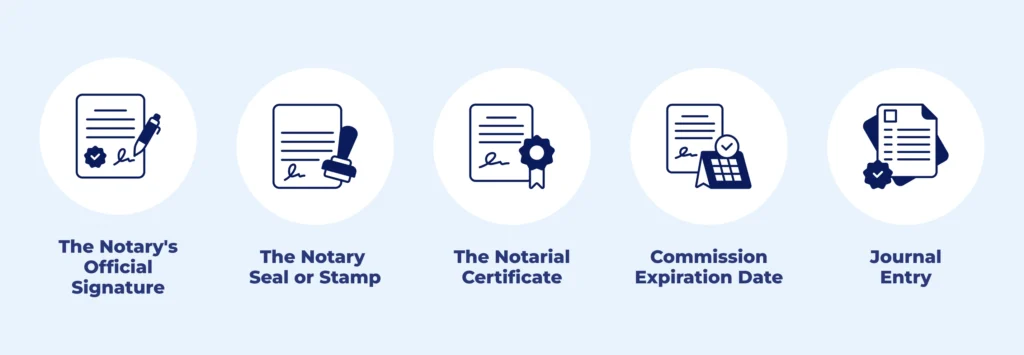
A notary public signature is often thought of as just a stamp on a document. Yet it includes several elements that work together. If one of these parts is missing, the notarization may be rejected.
1. The Notary’s Official Signature
This is the notary’s personal handwritten (or, in the case of remote notarization, electronic) signature, the same one registered with their commissioning state. It’s not interchangeable or delegable. Only the commissioned notary themselves can sign.
2. The Notary Seal or Stamp
Every notary has their official seal, which can be either an embossed or stamped version of their name, their commission number, their state, and their expiration date. In most states, the notary seal must be accompanied by their signature to make the document valid.
3. The Notarial Certificate
A block of text that includes information about what was done to the document, the date, the county and state in which the document was signed, and the parties involved.
4. The Commission Expiration Date
Notaries do not have lifetime commissions and are usually valid for about four years, although this varies in different states. The expiration date must be near the notary seal.
5. The Journal Entry (required in most states)
Most states require notaries to maintain a bound journal logging every notarial act, including the document type, date, signer’s ID presented, and signature. While the journal entry doesn’t appear on the document itself, it’s part of the official record and can be subpoenaed in legal disputes.
What Kind of Notarization Do You Actually Need?
Not all notarizations are the same. One common mistake is assuming that any notary signature works for any document. In reality, different documents require different types of notarial acts, and using the wrong one can lead to rejected paperwork.
1. Acknowledgment
This is the most frequently performed notarial act. In an acknowledgment, the signer appears before the notary and confirms, or acknowledges, that they signed the document willingly and that the signature is their own. The notary public verifies the identity of the person signing but does not observe the signing in real time.
Most commonly used for: real estate deeds, mortgages, powers of attorney, and contracts.
2. Jurat (Sworn Oath or Affirmation)
A jurat goes a step further. Here, the signer must physically sign the document in front of the notary and swear or affirm under oath that the contents of the document are true. The notary administers the oath and witnesses the signature.
Most commonly used for: affidavits, depositions, and court-filed statements.
3. Copy Certification
In this act, the notary certifies that a copy of an original document is a true, accurate, and complete reproduction. Not all states allow notaries to certify all document types, vital records like birth certificates, for example, typically must be certified by the issuing government agency instead.
Most commonly used for: passports, diplomas, licenses, and personal records.
4. Signature Witnessing
Similar to a jurat but without the sworn oath component. The notary simply watches the signer sign the document and verifies their identity. Some states treat this as its own distinct act; others fold it into acknowledgments.
Most commonly used for: wills, trusts, and certain financial documents.

Why Is a Notary Public Signature Legally Recognized?
A notary public signature is legally recognized because the notary is commissioned by the state government. This commission gives the notary the authority to verify identities, witness signatures, and confirm that a document was signed properly.
Thus, notary acts under state authority and notarized documents are accepted by courts, banks, government agencies, and other institutions.
Notaries Are Appointed by the State
A notary public is not self-appointed. They are commissioned by their state government, usually through the Secretary of State’s office. This means the state gives them the authority to perform notarizations.
When a notary signs and seals a document, they act as an official representative of the state, not as a private individual.
This is what makes a notary different from a regular witness. A witness only confirms that they saw something happen. A notary public certifies the signing and verifies the identity of the person signing, and they are legally responsible for doing this correctly under state law.
It Creates a Legal Presumption of Validity
In most U.S. jurisdictions, a properly notarized document carries a presumption of validity in court. That means the burden of proof shifts. Normally, it is up to the party who is submitting a document to prove that a signature is genuine. However, with a notarized document, it is up to the other party to prove that it is not genuine.
Notaries Are Personally Liable
This is the part most people don’t realize. If a notary signs a document incorrectly, doesn’t verify someone’s identity, is under pressure, or makes a false certificate, they could end up in serious trouble. They could lose their commission, pay civil damages, and even end up in prison for fraud and perjury, depending on what state they are in and what they did.
Interstate and International Recognition
Within the United States, notarized documents are recognized across all 50 states under the Full Faith and Credit Clause of the Constitution. However, if you want your document recognized in another country, there are some additional requirements, like Apostille. This is just a standard document from the Secretary of State, certifying the credentials of the notary public, but only for those countries that are members of the Hague Convention.
When Do You Actually Need a Notary Public Signature?
Most people only think about notarization when someone hands them a form and says “this needs to be notarized.” But you need to know exactly when and why certain documents require a notary public signature to save you from delays, rejections, and expensive re-dos.
Real Estate Transactions
Most real estate deeds, mortgage agreements, refinancing agreements, and title deeds require notary public signatures. Banks and county authorities require these documents to be signed in front of a notary public.
Estate Planning Documents
Wills, living trusts, and powers of attorney are among the most important documents a person will ever sign, and most states require them to be notarized to be enforceable. An unnotarized power of attorney, for example, will likely be rejected by banks, hospitals, and courts when you need it most.
Legal Affidavits and Sworn Statements
Any document that requires you to sign under oath requires the signature of a notary public. Sworn statements, self-proving affidavits, and statutory declarations are required in these cases.
Adoption and Family Law Documents
Parental consent forms, adoption paperwork, custody agreements, and name change petitions typically all require notarization. Given the sensitive nature of these documents, having a mobile notary service come to your home rather than handling them in a public office setting is an increasingly popular option.
Business and Financial Documents
Corporate resolutions, loan agreements, partnership contracts, and certain IRS forms all regularly require notarization. Businesses dealing with international partners may also need notarized documents accompanied by an Apostille for use abroad.
Immigration Forms
Several USCIS forms and supporting affidavits require notarized signatures. Errors or missing notarizations in immigration paperwork can cause significant processing delays.
Vehicle Titles
In many states, transferring a vehicle title requires a notarized signature from the seller. Requirements vary by state, so it’s worth checking your DMV’s specific rules before the transaction.
How the Notarization Process Actually Works
If you’ve never had a document notarized before, the process can feel intimidating. It shouldn’t. In most cases, a straightforward notarization takes less than ten minutes.
Step 1: Prepare Your Document
Before meeting with a notary, make sure your document is complete, every field filled in, every blank accounted for, except for the signature line. Do not sign the document in advance. This is one of the most common mistakes people make. Many notarial acts, particularly jurats, require the notary to physically witness the signing. A pre-signed document may force you to start over.
Step 2: Bring Valid, Government-Issued ID
Identity verification is at the core of what a notary does. You’ll need to present a current, government-issued photo ID, a driver’s license, passport, or state ID card are the most widely accepted. The name on your ID must match the name on the document exactly. An expired ID, in most states, will not be accepted.
Step 3: Appear Before the Notary
You must be physically present with the notary at the time of signing, unless you’re using a remote online notarization (RON) platform, in which case the appearance is conducted via live two-way video. There are no exceptions for convenience. A notarization performed without the signer present is fraudulent and legally void.
Step 4: The Notary Verifies Your Identity
The notary will examine your ID, compare it against the document, and may ask you to confirm identifying information. If anything raises a red flag, an expired ID, a name mismatch, signs of coercion, or uncertainty about the signer’s mental capacity, a professional notary is both entitled and obligated to refuse the notarization.
Step 5: You Sign the Document
Once your identity is confirmed, you’ll sign the document in front of the notary. For acknowledgments, you’re confirming the signature is yours and made willingly. For jurats, the notary will administer a brief verbal oath or affirmation before you sign.
Step 6: The Notary Completes the Notarial Certificate
The notary fills in the notarial certificate, recording the date, location, type of act performed, and the parties involved, then applies their official signature and seal. At this point, the document is legally notarized.
Step 7: The Journal Entry
In most states, the notary records the transaction in their official journal, noting the document type, date, ID presented, and your signature. This creates an auditable paper trail that can be referenced if the document is ever challenged.
What a Mobile Notary Service Changes About This Process

Every step above is identical whether you go to a notary or a notary comes to you, the legal requirements don’t change. What a mobile notary service changes is the logistics. Instead of scheduling time off work, finding a notary near you, and driving across town, you schedule an appointment and the notary arrives at your home, office, hospital room, or wherever you happen to be.
For real estate closings, estate planning signings, or any situation where multiple parties need to sign in the same place at the same time, the mobile model isn’t just convenient, it’s often the most practical option available.
Mobile Notary Service vs. Traditional Notary vs. Remote Online Notarization: Which One Do You Need?
Not long ago, the only way to get a document notarized was to find a bank, law office, or shipping store during business hours and hope a notary was available. Today, notarization is far more flexible. In most situations, you can choose between three different options: a traditional in-person notary, a mobile notary service that travels to you, or remote online notarization completed entirely through a secure digital platform.
The best option depends on several factors, including the type of document, your location, and how quickly the notarization must be completed.
Traditional Notary
The traditional notary is likely the most familiar option. This involves going to a physical location, such as a bank, law firm, library, or a shipping location such as a UPS Store, where a commissioned notary checks identification, witnesses signatures, and applies their stamp.
This option is best for simple documents and single signers. However, if you need a simple acknowledgment or jurat and are able to easily travel to a physical location during business hours, a traditional notary is likely the way to go.
One of the major benefits of traditional notarization is protection of your budget. For example, many banks offer free notarization services for bank account holders. Additionally, walk-in notary services are easily available in most urban and suburban locations.
However, traditional notarization can quickly become restrictive if timing is an issue. You need to coordinate your schedule with the availability of a traditional notary location. For example, if you are dealing with a real estate closing, coordinating multiple signers, and/or working with someone who is unable to travel, traditional notarization can quickly become inconvenient.
Mobile Notary Service
A mobile notary service works differently from a traditional notary. Instead of you traveling to an office, the notary comes to your location, such as your home, office, hospital, care facility, or another agreed meeting place.
Mobile notarization is especially helpful for complex or urgent situations. This includes real estate closings, estate planning documents, loan packages, and powers of attorney. It is also useful when someone cannot easily travel, when time is limited, or when documents must be signed in a specific location.
Because many mobile notaries work with these types of documents regularly, they often have experience handling larger document packages and multi-party signings. Some are also trained as loan signing agents, meaning they understand the structure of real estate loan documents and can help ensure signatures and initials are completed correctly.
The main downside is cost. In addition to the state-regulated notarization fee, mobile notaries usually charge a travel fee based on distance and time. For a simple document, visiting a bank or shipping center may be cheaper. But for important transactions where convenience, timing, and accuracy matter, a mobile notary is often the most practical option.
Remote Online Notarization (RON)
Remote Online Notarization (RON) allows the whole process to take place online, using a secure online environment. The signer and notary can connect using a live video call, and the notary can verify the signer, witness the signature, and apply their digital seal.
Remote Online Notarization has witnessed rapid growth, and by 2024, most states in the US have permanent RON laws in place, and technology for verification has become more advanced. The verification process is often more stringent and is done using knowledge-based questions and credentials.
Remote Online Notarization is particularly useful in cases where the signer and notary are in different states, or in cases where time is a constraint, such as for travelers, expatriates, etc.
However, not all cases can take advantage of RON, and some may require physical signatures and seals, and some agencies may not accept electronically notarized documents. It is therefore important to check the agency’s requirements before using RON.
So Which One Do You Actually Need?
If your document is straightforward and you can get to a notary easily, traditional works fine. If your signing involves real estate, multiple parties, someone who can’t travel, or a document package that needs to be handled carefully, mobile notary service is almost always the better call.
If you’re out of state, pressed for time, and your document type qualifies, mobile notary is worth exploring.
When in doubt, a reputable mobile notary service provider can typically advise you on which approach fits your specific document and jurisdiction, before you commit to anything.