Do You Need an Invitation Letter for a Russian Visa?
Planning a trip to Russia? You’ve probably encountered conflicting information about whether you need an invitation letter. The answer isn’t straightforward because it depends on your nationality, the type of visa you’re applying for, and which consulate you’re working with.
Some travelers need a formal invitation from a Russian company or host. Others can skip this step entirely. Still others discover too late that they applied for the wrong Russian visa type, wasting time and money.
Do You Need an Invitation Letter?
Start with your visa type. That’s what determines whether you need an invitation letter for a Russian visa, what kind you need, and who must issue it.
| Visa Type | Invitation Required? |
| Tourist Visa | YES – Tourist voucher / visa support |
| Private Visa | YES – Host-issued invitation |
| Business Visa | YES – Company-issued invitation |
| Study Visa | YES – University-issued invitation |
| Work Visa | YES – Employer-issued invitation |
| Humanitarian Visa | YES – Sponsoring organization |
| Transit Visa | NO – Onward ticket only |
| E-Visa | NO – No voucher, no invitation |
| Diplomatic/Official | NO – Special status |
For travelers unsure about their situation, the decision tree is simple: Are you staying longer than 72 hours and planning to actually be in Russia (not just passing through an airport)? If yes, you likely need an invitation. Are you a citizen of an e-visa-eligible country and able to apply online without submitting physical documents? If yes, you might skip the invitation requirement entirely.
What Is a Russian Visa Invitation Letter?
The term “invitation letter” in Russian visa terminology encompasses several different document types, which often confuses applicants. Understanding the correct terminology helps you request the right document.
Invitation Letter (Приглашение)
This is a formal document issued by the Russian Ministry of Interior (for private visits) or an authorized organization (for business, study, or work). It’s an official letter that confirms a Russian citizen or organization is inviting you to visit Russia.
Tourist Voucher (Туристический ваучер)
This is a confirmation from a hotel or licensed tour operator that you have accommodation booked in Russia. It’s the document tourists need instead of a traditional invitation letter.
Visa Support Document (Документ в поддержку визы)
This is an umbrella term for any document that supports your visa application, including invitations, vouchers, hotel confirmations, and employer letters.
FMS Official Invitation (Официальное приглашение ФМС)
This is an invitation issued directly through Russia’s Federal Migration Service (now called the Department of Citizenship and Immigration). It’s the most formal type and is typically used for private visits.
A valid Russian visa invitation must include several essential components. The document must show your full name exactly as it appears in your passport, the precise dates of your intended visit (entry and exit dates), your passport number, your date of birth, and the specific purpose of your visit. For private invitations, it must include the host’s name, address, and relationship to you.
For business invitations, it must include the company’s name, registration number, address, and the business purpose. Tourist vouchers must include the hotel’s name, registration number, address, and your booking confirmation number. All invitations must include a unique invitation or confirmation number, the issuing organization’s official seal and signature, and the date of issue.
When You Need an Invitation Letter
The tourist visa is the most common visa type for Russia, and it requires a tourist voucher rather than a personal invitation letter. When you book a hotel in Russia, you’re not automatically issued a voucher, you need to specifically request one or use a licensed tour operator.
A tourist voucher comes from your hotel or tour operator, not from you personally. When you book accommodation at a registered Russian hotel, you can request a tourist voucher as part of your booking. The hotel will issue this confirmation showing your stay dates, room details, and booking reference. This voucher serves as your visa support document and replaces the need for a personal invitation.
Tourist vouchers typically cost between $20 and $5,0, depending on the operator and processing speed. Express services that issue vouchers within 24 hours may cost slightly more. Standard processing usually takes 2-5 business days.

Private Visa Invitation (Visiting Friends or Family)
A private visa allows you to visit Russian friends or family members. This visa requires an invitation letter issued by your Russian host through the Federal Migration Service or designated government office.
The process is more complex than obtaining a tourist voucher. Your Russian host must apply to the local migration office (called FMS or, in Moscow and St. Petersburg, the Department of Citizenship and Immigration) to request an official invitation for you. They’ll need to provide their passport, proof of residence, and information about you, including your full name, date of birth, passport number, and the relationship between you.
Processing time for private invitations is typically 20-30 days from the date your host applies. Your host will receive an official letter from the migration office that they can then send to you (usually by mail or courier). Once you receive this letter, you can use it to apply for your visa at a Russian consulate.
Business Visa Invitation
Business visas are designed for people conducting business in Russia, attending conferences, or engaging in commercial activities. These visas require a business invitation issued by a Russian company or organization.
Business invitations come in three formats.
- A Telex invitation is an electronic invitation transmitted directly from the Russian company to the Russian consulate. This is the fastest option and typically takes 3-7 business days.
- A hard copy invitation is a printed letter issued by the company that you receive directly and submit with your visa application. This typically takes 7-14 business days.
- An electronic invitation is a digital document issued through Russia’s online system that you can view and download. Processing time varies but is usually 5-10 business days.
Not just any Russian company can issue a business invitation. The company must be registered with the Russian tax authorities and have a valid business license. The invitation must include the company’s official seal, registration details, the business purpose, and your full details, including passport number.
Business invitations typically cost between $40 and $180, depending on the type and urgency. Express services offering same-day or next-day processing are available but cost significantly more. Many visa support companies specialize in obtaining business invitations and can handle the entire process on your behalf.
Humanitarian, Study, and Work Invitations
Humanitarian visas (for medical treatment, religious activities, or disaster relief), study visas, and work visas all require official invitations from the sponsoring organization.
For study visas, the Russian university or educational institution must issue an official invitation through the Russian Ministry of Education. This invitation confirms your enrollment, the program duration, and the course of study.
For work visas, your Russian employer must file official documentation with Russian labor authorities and obtain an invitation confirming your employment. The employer must have already received work permission from the Russian authorities before they can issue your work invitation.
Note: All these invitations must come from official, registered organizations. Processing times vary but typically take 2-6 weeks, depending on the organization and whether all documentation is complete.
When You Do NOT Need an Invitation
Several visa categories don’t require invitations.
- Transit visas are for travelers passing through Russia to reach another destination, with no intention to stay in Russia itself. Transit visas require only proof of onward travel (like an airline ticket) and are valid for up to 72 hours. You don’t need any invitation or hotel voucher.
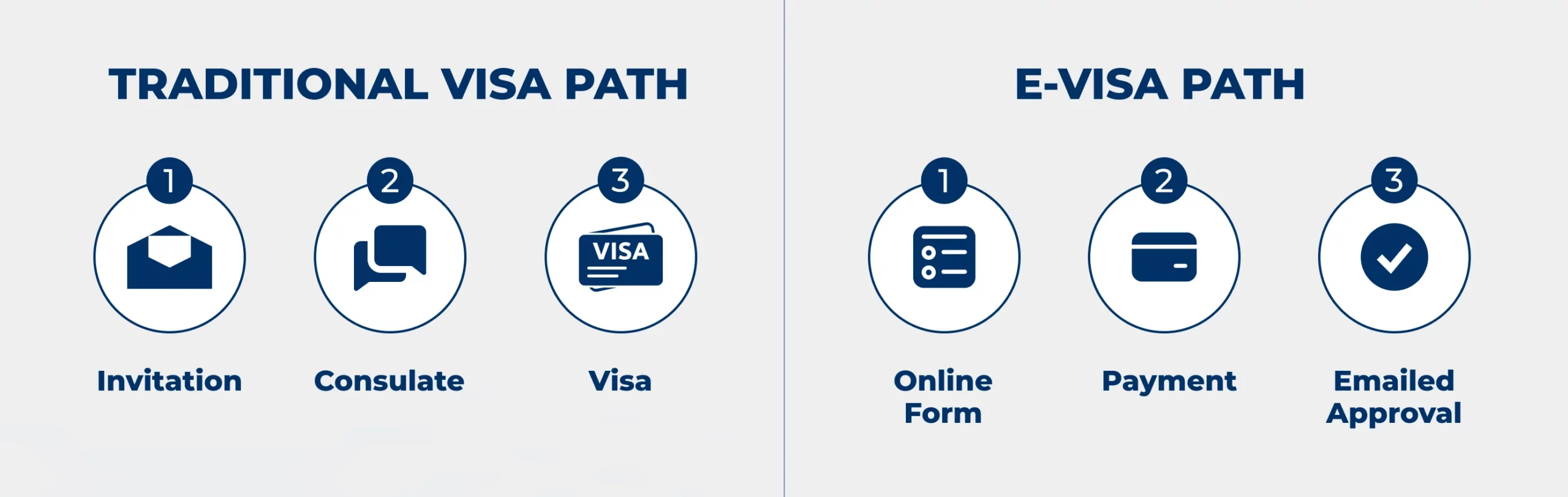
- E-visas are one of Russia’s newest visa options and explicitly don’t require invitations, vouchers, or hotel confirmations. E-visas are an electronic visa issued entirely online without requiring physical documents to be submitted to a consulate. We’ll cover e-visas in detail in the next section.
- Diplomatic and official visas for government representatives, journalists on official assignment, and certain other categories don’t require standard invitations because these travelers have special status.
E-Visa: No Invitation Needed
Russia’s e-visa program, launched in 2021, simplified visa procedures for citizens of eligible countries. The most significant advantage of the e-visa is that it requires no invitation letter, no hotel voucher, and no visa support documents of any kind.
To apply for a Russian e-visa, you need only four things: a valid passport with at least six months of validity remaining, a recent digital photo (typically 3×4 cm), your personal information (name, date of birth, contact details), and the ability to pay the visa fee online (around $40). You complete the application entirely online on Russia’s official e-visa portal, upload your photo, and receive your approved visa electronically. The entire process typically takes 3-5 business days. There’s no need to visit a consulate, submit physical documents, or provide any proof of accommodation or sponsorship.
However, e-visas come with important limitations. They’re valid for only 30 days. They can only be used for a single entry; if you leave Russia and want to return, you need a new e-visa. They’re only available to citizens of specific countries. They can only be obtained by foreign nationals applying outside Russia, you can’t apply for an e-visa if you’re already in Russia.
E-Visa Eligible Countries
Argentina, Austria, Azerbaijan, Bahamas, Bahrain, Barbados, Belarus, Belgium, Brazil, Brunei, Bulgaria, Canada, Chile, Croatia, Cyprus, Czech Republic, Denmark, Dominican Republic, Ecuador, El Salvador, Estonia, Finland, France, Germany, Greece, Grenada, Honduras, Hong Kong, Hungary, Iceland, India, Indonesia, Ireland, Israel, Italy, Jamaica, Japan, Jordan, Kazakhstan, Kenya, Kiribati, Kuwait, Kyrgyzstan, Latvia, Liechtenstein, Lithuania, Luxembourg, Malta, Mexico, Micronesia, Monaco, Montenegro, Namibia, Netherlands, New Zealand, Nicaragua, Norway, Oman, Palau, Panama, Paraguay, Peru, Philippines, Poland, Portugal, Qatar, Romania, San Marino, Saudi Arabia, Serbia, Seychelles, Singapore, Slovakia, Slovenia, South Africa, South Korea, Spain, Suriname, Sweden, Switzerland, Taiwan, Tajikistan, Thailand, Timor-Leste, Turkey, Turkmenistan, Uganda, United Arab Emirates, United Kingdom, United States, Uruguay, Uzbekistan, Vanuatu, Venezuela, Vietnam.
If your country is not on this list, you must apply for a traditional visa (tourist, private, business, etc.) through a consulate, and you’ll need the appropriate invitation letter or voucher.
For e-visa applicants, the decision is simple: you don’t need an invitation letter. You don’t need to book a hotel and request a voucher. You don’t need anyone to sponsor you. You simply apply online, and if approved, your visa is emailed to you.
How to Get an Invitation Letter
The simplest way to obtain an invitation is to book a hotel at a registered Russian hotel and request a tourist voucher from them. When you have a confirmed hotel booking, most hotels in Moscow, St. Petersburg, and other major cities can issue a voucher within 2-7 business days for free or a small fee ($5-$15).
To get a hotel voucher, contact the hotel where you’ve made a reservation. Ask them directly if they can issue a tourist voucher for visa purposes. Provide your full name, passport number, date of birth, and your intended stay dates. The hotel will verify its authorization to issue vouchers and send you the document, typically by email. This voucher is then included with your visa application at the consulate.
The advantage of hotel-issued vouchers is that they’re inexpensive and relatively quick. The disadvantage is that not all hotels offer this service; small hotels or those not officially registered may not be able to issue vouchers. Additionally, you must have a legitimate hotel booking to request a voucher.
Licensed Tour Operator
Licensed tour operators are professional visa support services that can issue tourist vouchers for any registered Russian hotel. These operators have established relationships with hotels throughout Russia and can quickly obtain vouchers.
To use a tour operator, visit their website, select your travel dates, and request a tourist voucher. You’ll provide your passport details, full name, and intended stay dates. Most operators can issue a voucher within 24-48 hours. Costs typically range from $20-$50, though express services may cost more.
Tour operators are the fastest and most reliable option for tourist vouchers if your hotel cannot provide one. Many travelers who don’t actually book hotels through tour operators use them solely for obtaining the voucher needed for their visa application.
Host-Issued Invitation for Private Visits
If you’re visiting Russian friends or family, your host can apply for an official invitation through the Federal Migration Service. The process requires your host to visit a local migration office in Russia with specific documents.
Your Russian host needs to bring their passport, proof of residence (utility bill or lease), a completed application form, and information about you including your full name, date of birth, passport number, nationality, and the relationship between you. The migration office will process the application and issue an official invitation letter within 20-30 days. Your host can then mail or courier this invitation to you.
This option is free but slow. It’s ideal for planned visits where you have adequate advance time to arrange the invitation. If you need a visa quickly, a tourist voucher is a faster alternative even if you’re actually staying with family.
Business Invitation Through Your Company
If you’re traveling for business, your Russian business partner or the Russian office of your company can issue a business invitation. For companies with their own Russian operations, the process is straightforward; they submit a request to the appropriate government office and provide the official invitation.
For international companies without Russian offices, you may need to work with a visa support agency that can coordinate with a Russian business partner or intermediary to invite on their behalf.
Business invitations vary in processing time but typically take 5-14 business days, depending on the type (Telex, hard copy, or electronic) and whether all documentation is complete.
Step-by-Step Guide on How to Get a Russian Visa for US Citizens
There are multiple steps to get your Russian visa. Here’s a step-by-step rundown of what you have to do:
Step 1: Determine the Type of Visa You Need
Figure out what you want to do on your trip. Knowing your visa type will guide the rest of the process, whether it’s for tourism, business or transit.
Step 2: Gather Your Documents
Gather all the required documents mentioned previously. Make sure your passport is valid and you have a good passport photo. You invitation will need to be notarized. Our team at Rush In Documentation can help you with mobile notary at Los Angeles.
Step 3: Complete the Online Visa Application Form
Go to the official visa application portal of Russia and complete your form. Be ready to answer questions about your personal information, your travel, and information from the letter of invitation.
Step 4: Submit Your Application
And after filling out your form, you can print it out and sign it. Find the nearest Russian consulate or visa center and apply in person. Some consulates also accept mail-in submissions, but most typically require in-person visits for fingerprinting and verification.
Step 5: Pay the Visa Fee
The visa fee for a Russian visa is based on type and processing time. Expedited processing, for example, comes with higher fees. Methods of payment vary by consulate, so check their guidelines ahead of time.
Step 6: Wait for Processing
Regular processing times average 4 to 20 business days. With expedited services, this timeframe can be as short as three days. Be sure to plan in advance so that you receive your visa prior to your travel date.
Step 7: Collect Your Visa
After approval, you can retrieve your visa at the consulate or visa center. Before travelling to any place, ensure that all details printed on your visa are accurate.
For a no-hassle experience, companies like Rush In Documentation can help you with our Russia visa services
How Much Does a Russian Invitation Letter Cost?
Cost varies significantly depending on the type of invitation and processing speed you choose.
Tourist Vouchers
Standard processing (2-5 business days) typically costs $20-$50. Express processing (24-48 hours) may cost $50-$100. Hotel-issued vouchers from your booking hotel may be free or cost only $5-$15.
Private Invitations
These are free if your Russian host applies through official government channels. However, you must factor in your host’s time and potentially travel to the migration office. If you use a visa support agency to coordinate the private invitation, they typically charge $30-$100.
Business Invitations
Costs vary widely based on processing type. Standard hard-copy invitations typically cost $40-$100. Telex invitations (fastest) cost $60-$180. Electronic invitations typically cost $50-$120. Rush services cost significantly more.
Study/Work/Humanitarian Invitations
These typically have no separate cost; the educational institution, employer, or sponsoring organization provides them as part of the enrollment, employment, or program process. However, if you use an agency to coordinate these, there may be fees of $50-$200.
Many visa support companies offer package deals that include obtaining an invitation, preparing your complete visa application, and providing guidance throughout the process. These packages typically cost $80-$300, depending on visa type and included services.
What Can Cause Visa Rejection?
Many visa applications are rejected due to simple but critical mistakes that could have been avoided with proper attention to detail.
Using a Fake Voucher or Invitation
Never use fraudulent or misrepresented documents. Some people book hotel vouchers but don’t actually plan to stay at the hotel, or use someone else’s invitation. Consulates verify all documents, and providing false documents can result in visa denial, blacklisting from Russia, and legal consequences. Always use legitimate invitations that match your actual travel plans.
Wrong Dates on Your Invitation
Your invitation dates must match your intended travel dates. If your voucher says you’re staying June 1-10, but you apply for a visa valid June 5-30, this discrepancy raises red flags. Ensure your invitation dates and visa application dates align exactly.
Invitation Doesn’t Match Your Visa Purpose
If you claim you’re visiting family (private visa) but your invitation is a hotel voucher, or you claim business travel but have a tourist voucher, this mismatch will cause rejection. Your invitation must correspond exactly to your stated purpose.
Staying at Private Accommodation, But Showing Hotel Voucher
Never show a hotel voucher for a different location than where you’re actually staying. If you’re staying with family but present a hotel voucher, consulates will question your honesty. If staying with family, use a private invitation, not a hotel voucher.
Misspelled Name or Wrong Passport Number on the Invitation
Verify that every letter of your name is spelled identically on the invitation, visa application, and passport. A single mismatched character (like “Catherine” vs. “Katherine” or “Smith” vs. “Smyth”) can cause rejection. Similarly, ensure the passport number on the invitation matches exactly, no transposed digits.
Damaged, Faded, or Poor-Quality Document
Consulates need to clearly see all information on your invitation. If the document is faded, damaged, or of poor quality, request a replacement. Don’t submit borderline documents; get a clear, pristine copy.