How to Apostille a Birth Certificate for Immigration
Immigrating to another country often involves gathering a long list of documents to prove your identity, family relationships, and eligibility. One requirement that appears across nearly all visa, residency, and citizenship applications is the need for an apostilled birth certificate. If you’ve never encountered the process of an apostille of a birth certificate for immigration before, the concept can seem confusing, but the process is simpler than it appears once you understand the purpose behind it.

What is an Apostille?
An apostille is a special certificate issued by a state authority that verifies your birth certificate is genuine. Immigration offices abroad rely on apostilles because they cannot contact every U.S. vital records office individually to confirm whether a document is real. With an apostille attached, your birth certificate becomes instantly recognizable and valid in any member country of the Hague Apostille Convention, which includes more than 140 nations.
This requirement applies whether you’re applying for long-term residency, marriage registration, dual citizenship, a work permit, or family reunification. Immigration systems depend on authentic, verifiable documents, and the apostille provides exactly that.
Why Immigration Offices Require an Apostille on Your Birth Certificate
Immigration authorities must verify the authenticity of every document you provide. Since each U.S. state issues its own birth certificates, immigration offices abroad need a reliable way to confirm that the document you submit is truly official. This is why they require an apostille, a standardized certification internationally recognized as proof of authenticity.
An apostille confirms that the signature and seal on your birth certificate belong to a legitimate state official. Immigration officers don’t evaluate the information on your certificate; they evaluate whether the document itself is genuine. The apostille gives them the confidence to accept your birth certificate without question.
Countries that participate in the Hague Apostille Convention accept apostilles instead of embassy legalization. This agreement dramatically simplifies cross-border document verification. For non-Hague countries, an apostille alone is not enough; you must complete additional steps through the U.S. Department of State and the destination country’s embassy.
Documents That Typically Require an Apostille for Immigration
Although your birth certificate is the primary document immigration offices request, most applications require several others. These help foreign authorities confirm identity, civil status, family relationships, and background. Because each document is issued by a different U.S. agency, it must be authenticated through an apostille before use abroad.
A birth certificate is always required. If applying through a spouse or if your name changed due to marriage, your marriage certificate must also be apostilled. Applicants who were previously married must submit an apostilled divorce decree or annulment order to verify legal status.
Here are some of the most common documents that immigration authorities may require apostilled:
- Marriage certificate. Needed if you’re applying through a spouse or if your name changed through marriage.
- Divorce decree or annulment. Required to confirm legal marital status if you were previously married.
- Adoption papers. Necessary when establishing legal parentage or dependent status.
- Background check or police clearance. Many countries require state or FBI records for long-term visas.
Employment-based immigration may also require you to apostille:
- Diplomas, transcripts, or professional certifications. Used to verify your qualifications.
If someone is helping manage your immigration case, you may need to apostille a power of attorney so they can legally act on your behalf. Each document serves a different purpose, but the apostille process remains the same across all of them. Once you learn how to apostille your birth certificate, the remaining documents follow an identical workflow.
How to Apostille a Birth Certificate for Immigration
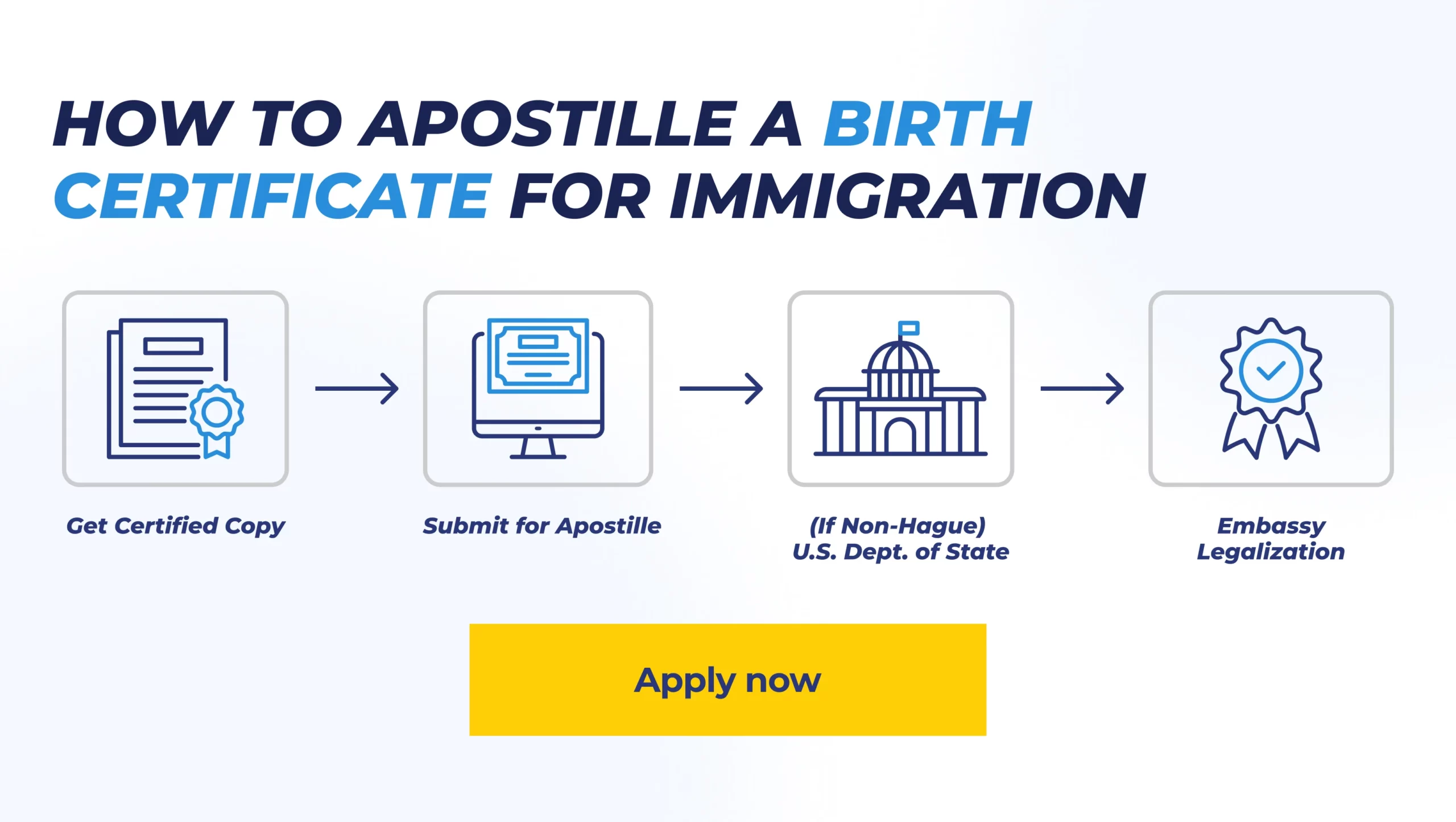
Apostilling a birth certificate is a simple process once you understand the sequence. Every step matters because immigration authorities will only accept documents that are issued correctly, certified correctly, and authenticated by the right state office. Below is a clear walk-through of how the process works from start to finish.
Step 1: Ensure You Have the Correct Birth Certificate Version
Not all birth certificates can be apostilled. Immigration authorities almost always require the long-form birth certificate, which includes detailed information about you and your parents. Short-form versions, or wallet-sized certificates, are not suitable.
Hospital-issued keepsake birth records are not official documents and cannot be apostilled. Only a certified copy issued by your state’s vital records office is acceptable. If your document is damaged, faded, or too old, order a new certified copy before proceeding.
Step 2: Order a New Certified Copy (If Needed)
If you don’t have a suitable copy, request one from the vital records office in the state where you were born. You can typically order in person, by mail, online, or by phone.
When it arrives, check for essential features such as:
- Raised or embossed seal
- Signature of the state registrar
- Certificate number
- Official letterhead
Order extra copies to avoid delays later. Most states process requests within 3–15 business days, with expedited options available.
Step 3: Determine Whether You Need a State or Federal Apostille
Birth certificates are state-issued, so the apostille must come from the Secretary of State where the document was issued, not where you live now. Many applicants mistakenly send documents to the wrong office or to the U.S. Department of State, which does not apostille state records.
Each state has its own authentication rules, forms, and fees. Checking your state’s official website before mailing anything prevents delays.
Step 4: Submit the Certificate for Apostille
Once you have the correct certified copy, submit it to your state’s Secretary of State for authentication. Most states allow three submission methods: by mail, in person, or online (if available). In-person submissions are usually the fastest, often completed the same day. Mail-in requests take anywhere from 5 to 14 business days, depending on processing volume.
When submitting, include the certified birth certificate, the state’s apostille request form, payment, and your return address. Some states ask for the destination country, which helps ensure the apostille is formatted correctly. Avoid sending photocopies or altered documents; immigration authorities require original certified copies.
Apostilles are attached directly to your birth certificate, usually as an additional page. Once issued, your document becomes internationally valid in all Hague Convention countries.
Step 5: Special Case, Non-Hague Countries Require Legalization
If your destination country is not part of the Hague Convention, you must complete legalization, a longer, multi-step process.
You will need:
- State apostille
- U.S. Department of State authentication
- Embassy or consulate legalization
Countries requiring this include the UAE, Saudi Arabia, Qatar, Kuwait, and others. This process typically takes 4-8 weeks, depending on embassy timelines.
How Long Does It Take to Apostille a Birth Certificate?
The total timeline depends on whether you already have a certified long-form birth certificate and how quickly your state processes apostilles. For example, in California apostille takes from 1 day to 4 weeks. Most applicants underestimate how long each stage takes, especially when mailing documents. Immigration deadlines can be strict, so planning ahead is essential.
If you already have the correct certified birth certificate, the apostille itself is usually the quickest part of the process. Most states process apostilles in just a few days, but delays can occur during busy seasons or holidays. If you need to order a new birth certificate first, expect the timeline to stretch longer, as vital records offices often have their own processing queues.
| Stage | Typical Timeframe | Notes |
| Standard apostille processing | 5-14 business days | Applies to most mail-in requests. Timing varies by state workload. |
| In-person apostille processing | Same day or 24 hours | Fastest option but requires visiting the state’s Secretary of State office. |
| Ordering a new certified birth certificate | 3-15 business days | Required if you only have a short-form, damaged, or outdated certificate. Expedited service often available. |
| Mailing time (standard) | 3-5 days each way | Depends on USPS delivery speed. |
| Mailing time (express) | 1-2 days each way | Recommended for urgent immigration cases. |
| U.S. Department of State authentication (non-Hague countries) | 1-2 weeks | Required after the apostille for non-Hague destinations. |
| Embassy/consulate legalization(non-Hague countries) | 1-3 weeks | Final approval step for countries that don’t accept apostilles. |
Cost to Apostille a Birth Certificate
The total cost of apostilling a birth certificate depends on your state fees, whether you need expedited service, and whether your destination country requires additional legalization. Although the process is generally affordable, the expenses can add up when you factor in shipping, translations, and federal or embassy authentication for non-Hague countries.
The apostille fee itself varies by state. Some states charge as little as $5, while others charge $20- $25 per document. If you need to order a new certified birth certificate, the cost is separate and usually ranges from $15 to $45, depending on the state. Many vital records offices offer expedited processing for an additional cost, which helps if you have a tight immigration deadline.
| Cost Category | Typical Price Range | Details |
| Apostille (State Fee) | $5-$25 | Charged by your state’s Secretary of State per document. |
| Certified Birth Certificate | $15-$45 | Required if you need a new long-form certified copy. |
Because every document must be handled separately, many people choose to apostille multiple documents at once to save time and shipping costs. Some use professional apostille services, which typically charge an additional $50–$150depending on the complexity and speed required.
In most cases, expect to spend $80-$150 total if you’re apostilling a single birth certificate. If translations, expedited processing, or embassy legalization are required, the cost may reach $150–$300+. Planning your budget in advance ensures there are no surprises along the way.
What Causes Delays in Immigration Applications
Even small mistakes during the apostille process can lead to significant delays in your immigration timeline. Many applicants assume their birth certificate is valid only to learn later that it’s the wrong version or improperly authenticated. Immigration authorities do not make exceptions, so avoiding these mistakes is crucial.
One of the most common issues is using a short-form birth certificate or a hospital-issued keepsake, neither of which can be apostilled. Another frequent mistake is sending documents to the wrong authority, for example, mailing a birth certificate to the U.S. Department of State instead of the issuing state’s Secretary of State. This results in returned documents and lost time.
Delays also occur when applicants submit photocopies, laminated documents, or certificates with handwritten modifications. Some countries require birth certificates issued within a specific timeframe (such as the last 6 or 12 months), and older documents may be rejected. Missing translations or using translators who are not certified also leads to rejections.
To avoid setbacks, double-check requirements, use only original certified copies, and confirm whether your destination country has age or translation rules before submitting your application.
Make Your Immigration Process Smooth and Stress-Free
Getting your birth certificate apostilled is a necessary step for nearly every immigration application, whether you’re pursuing residency, employment, marriage registration, or citizenship abroad. While the process may seem detailed, it becomes manageable once you understand the sequence: obtain the correct long-form certified copy, submit it to the correct state authority, and follow additional legalization steps if your destination country requires them.
Small mistakes, like using the wrong certificate version, forgetting a translation, or sending documents to the wrong office, can cause unnecessary delays. By following the steps outlined in this guide and preparing ahead, you can ensure your apostilled birth certificate is accepted without complications.
If you’re on a tight deadline or prefer professional assistance, apostille services can manage everything on your behalf, from obtaining certified copies to completing state, federal, and embassy authentication.