Documents That Need an Apostille: Complete List and Requirements

If you’ve been asked to provide an apostille for a document, chances are you were given very little explanation beyond “it’s required.” Most people discover apostilles only when they’re facing an important deadline, getting married abroad, applying for a visa, adopting a child internationally, studying overseas, or handling a business or legal matter in another country.
The problem? Government websites explain how apostilles work, but rarely explain which documents actually need one or how to tell if your specific document qualifies. Instead, you’re left navigating technical language, state-by-state rules, and scattered information that often creates more confusion than clarity.
Before determining whether your document needs an apostille, it’s essential to understand what an apostille actually is and what it is not. Many people assume an apostille “certifies” the document itself, but its role is much more specific.
What is an Apostille and When Do You Need It?
An apostille is an official certificate attached to a document that confirms the authenticity of key elements, not the information inside the document. Specifically, an apostille verifies that:
- The signature on the document is genuine
- The person who signed it had the legal authority to do so
- The seal or stamp on the document is authentic
Apostilles are used only for documents submitted to countries that are parties to the 1961 Hague Apostille Convention, an international treaty designed to simplify document authentication between member countries.
The apostille itself is usually a single-page certificate that is attached to the original document or certified copy. It does not translate the document, approve its contents, or confirm that the information is accurate; it simply certifies that the document was issued correctly or notarized by a recognized authority.
When You Might Need an Apostille
You may need an apostille anytime a U.S.-issued document must be legally recognized in another country. Common situations include:
- Submitting U.S. documents to foreign governments or institutions
- Conducting international business transactions or corporate registrations
- Immigration, citizenship, or international adoption proceedings
- Verifying educational credentials for study or employment abroad
- Using legal or court documents in proceedings outside the United States
In all of these cases, the foreign authority needs proof that your document is legitimate, and the apostille serves as that internationally recognized verification.
Now that you understand what an apostille is, the next step is to determine whether your specific document actually needs one, which we’ll break down in the decision guide that follows.
How to Determine If Your Document Needs an Apostille
Not every document automatically qualifies for an apostille, and not every situation requires one. Whether you need an apostille depends on three core factors: where the document was issued, where it will be used, and whether it meets formatting requirements.
1. Where the Document Was Issued
An apostille can only be issued by the authority that governs the place where the document originated.
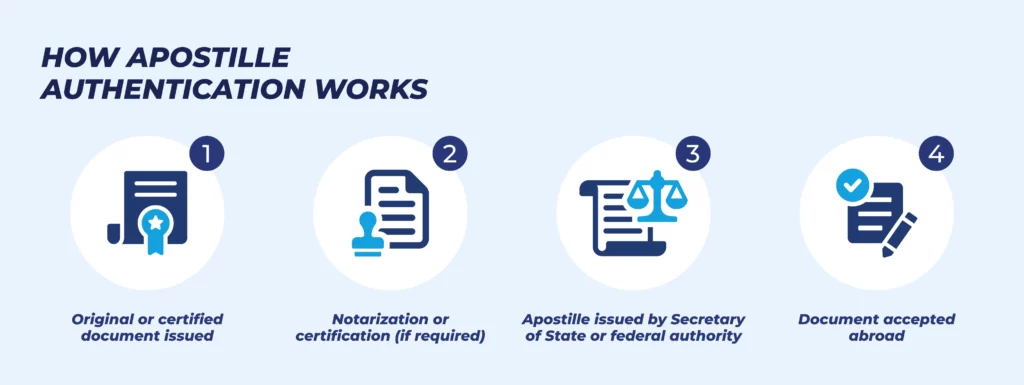
State-issued documents, such as birth certificates, marriage licenses, or notarized affidavits, must be apostilled by the Secretary of State in the state where they were issued. Federally issued documents, including FBI background checks and federal court records, must be apostilled by the U.S. Department of State.
If your document was issued outside the United States, it cannot receive a U.S. apostille and will follow the authentication rules of the issuing country.
2. Where the Document Will Be Used
Apostilles are valid only for countries that are members of the Hague Apostille Convention. If the destination country is a member of the Hague Convention, an apostille is sufficient. If the destination country is not a Hague member, the document must go through full legalization, which usually involves multiple government offices and the destination country’s embassy or consulate.
This Hague vs. non-Hague distinction is one of the most common reasons documents are delayed or rejected.
3. The Type and Format of the Document
Even if the issuing authority and destination country are correct, the document itself must qualify. It must be an original or certified copy, properly notarized or officially issued, and free from alterations such as lamination, corrections, or unofficial copies.
Photocopies, scans, or improperly notarized documents are frequently rejected before apostille processing even begins.
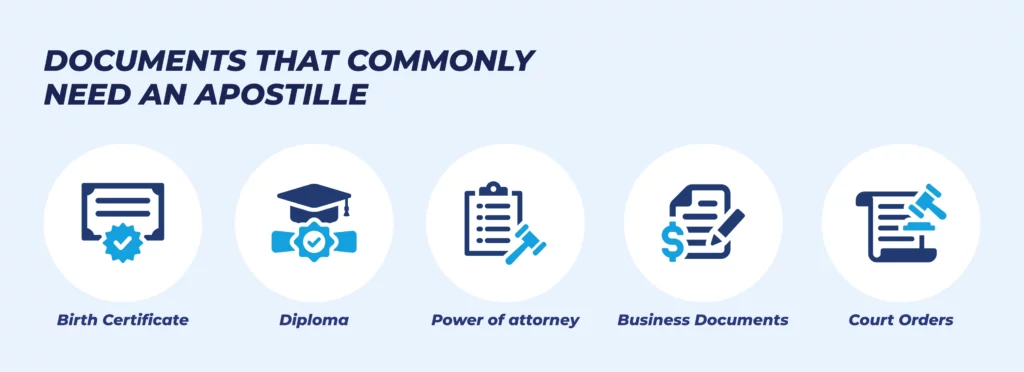
Complete List of Documents That Commonly Need an Apostille
Let’s see how apostille authorities and international institutions actually review documents, not just how they’re labeled, so you can quickly assess whether your document is likely to qualify and what preparation steps may be required.
Vital Records
Vital records are among the most frequently apostilled documents, particularly for immigration, marriage abroad, citizenship claims, and inheritance matters.
Common examples include birth certificates, marriage certificates, divorce decrees, death certificates, and certificates of single status.
These documents almost always must be certified copies issued by the state or county registrar where the event was recorded. In most states, notarized photocopies are not accepted for apostille purposes. Submitting the wrong version is one of the most common causes of immediate rejection.
Educational Documents
Educational records are commonly apostilled for international study, employment, professional licensing, and credential evaluations.
This category includes diplomas, academic transcripts, enrollment verification letters, teaching credentials, and other academic certifications.
Unlike vital records, educational documents are rarely apostilled in their original form. Most states require either school-issued certification, registrar verification, or notarization of the document before an apostille can be issued. Requirements vary significantly by state and institution, making this one of the most error-prone categories.
Legal and Court Documents
Legal documents used in international proceedings must meet strict formatting and notarization standards.
Common examples include court judgments, affidavits, powers of attorney, custody orders, and adoption paperwork.
Even when issued by a court, these documents may still require certified copies or judicial certification to be eligible for an apostille. Minor formatting issues, missing seals, or improper notarization frequently result in rejection.
Business and Corporate Documents
Business documents are commonly apostilled for international expansion, banking, contracts, and regulatory compliance.
Typical documents include articles of incorporation, certificates of good standing, business contracts, board resolutions, and trademark or patent-related paperwork.
Improper notarization is especially common in this category, particularly with electronically signed documents or documents executed outside the U.S. Apostille authorities require clear proof of authority, original signatures where needed, and compliant notarization.
Immigration and Identity Documents
These documents are often required for visas, residency permits, employment authorization, and background verification.
Examples include FBI background checks, state police clearances, name change documents, and correctly notarized passport copies.
Federal documents, such as FBI background checks, follow a different apostille process than state-issued records. Submitting a federal document to a state office—or vice versa—will always result in rejection.
Apostille vs. Legalization: What’s the Difference?
This distinction determines the entire authentication path your document must follow. Choosing the wrong process is one of the most common and most expensive mistakes in international document preparation.
What is an Apostille?
An apostille is a standardized international certification used only when the destination country is a member of the Hague Apostille Convention. It confirms the authenticity of the signature, the authority of the signer, and the legitimacy of the seal or stamp on the document.
Once issued, the apostille is recognized by all Hague member countries and serves as the final form of authentication. No embassy or consular involvement is permitted or required after this step.
When an Apostille Is the Correct Process
An apostille is required when a document issued in one country is intended for use in another country that is a party to the Hague Convention. In these cases, the apostille replaces all other forms of international authentication. Attempting to add additional certifications after an apostille is issued can invalidate the document.
What is Document Legalization?
Legalization is a multi-stage authentication process required when the destination country is not a member of the Hague Convention. Instead of a single certificate, legalization involves a chain of verifications, with each authority confirming the legitimacy of the previous one.
This process often includes state-level authentication, federal authentication when applicable, and final certification by the destination country’s embassy or consulate. Each step is mandatory, and skipping even one will cause rejection.
When Legalization Is Required
Legalization applies when the destination country does not recognize apostilles or when a receiving authority specifically requires consular authentication. This is common for certain immigration, business, and legal uses in non-Hague countries.
Submitting an apostille in these situations, even if it was issued correctly, will almost always result in automatic rejection.
Why Apostilles and Legalization Are Not Interchangeable
Although apostilles and legalization both serve the purpose of international document recognition, they operate under entirely different legal frameworks. A document can follow only one path, never both.
If the destination country requires legalization, an apostille has no legal value. Likewise, if the government is a member of the Hague Convention, legalization is unnecessary and is often refused.
What to Do Before You Submit Your Documents
Before beginning the apostille process, it’s essential to complete a few verification steps. Most apostille delays and rejections occur before a document ever reaches the issuing authority, simply because one of these checks was skipped.
Confirm the Destination Country
Start by identifying the exact country where the document will be used. Apostille requirements are determined by the destination, not by the document type or the reason it’s needed. Even documents that look identical may follow entirely different authentication paths depending on where they are being submitted.
Verify Hague Convention Status
Next, confirm whether the destination country is a member of the Hague Apostille Convention. Hague member countries accept apostilles as final authentication. Non-Hague countries require full legalization instead. This single distinction determines whether your document will be processed in one step or several.
Determine Certification or Notarization Requirements
Review whether your document must be certified or notarized before an apostille can be issued. Vital records usually require certified copies, educational documents often need school or registrar certification, and many legal or business documents must be properly notarized. Submitting an uncertified or improperly notarized document will result in rejection.
Ensure the Document Is Current and Unaltered
Apostille authorities will reject documents that are expired, laminated, modified, or contain handwritten changes. The document must be in its original or officially certified form, with all seals, signatures, and text clearly visible.
Confirm Whether Translation Is Required
An apostille authenticates a document’s signature and seal, it does not translate the content. Many destination countries require certified translations in addition to the apostille. Verifying translation requirements in advance prevents last-minute delays after authentication is complete.
Get Your Apostille Done Right the First Time
Apostille requirements can feel overwhelming, especially when deadlines are tight and international rules are unfamiliar. While the process itself is standardized, the details matter, and small mistakes can quickly derail essential plans.
If you’re unsure whether your document qualifies or which authentication path applies, having it reviewed before submission can save you time, stress, and unnecessary delays.
FAQ
How long does an apostille take?
Processing time depends on the issuing authority and whether you choose standard or expedited service. In most U.S. states, standard apostille processing takes 5-15 business days. Expedited services can shorten this to 1-3 business days, and in limited cases, same-day processing may be available.
Can I get an apostille rushed or expedited?
Yes. Many Secretary of State offices offer expedited options for an additional fee. Third-party document services can also hand-carry documents for faster turnaround, especially when deadlines are tight.
Do I need an apostille if I’m not sure?
If a foreign authority requested your document and didn’t specify “apostille” or “legalization,” it’s important to confirm before submitting. Getting the wrong authentication (or skipping it) can result in rejection and delays. When in doubt, verify requirements with the receiving country or institution first.
What if my document is in another language?
Apostilles do not translate documents. If the destination country requires a translation, you must arrange that separately. In many cases, the document is apostilled first, then translated, with the translation notarized if required.
Can I apostille a photocopy?
Only if the photocopy is properly notarized as a true copy by a notary public and the destination country accepts notarized copies. Many countries require original or certified documents instead, so always confirm acceptance rules in advance.
Do I need an apostille for a certified copy of a certified copy?
Usually, no. Most authorities will reject second-level certifications. Apostilles are typically issued on original documents or on the first certified copy issued by the appropriate government agency.
What if my country isn’t on the Hague list?
If the destination country is not a member of the Hague Apostille Convention, you’ll need full legalization, not an apostille. This is a longer, multi-step process that may involve state authentication, federal certification, and embassy or consulate legalization.
Can I get multiple apostilles for one document?
Yes. If multiple countries require the same document, you can request multiple apostilles, but each one must be attached to a separate original or certified copy. One apostille cannot be reused for different countries.
How much does an apostille cost?
Government fees are typically $5-$25 per document, depending on the state or country. Expedited handling, shipping, and professional processing services can increase the total cost, especially for urgent or international requests.